Showing posts with label Old Cairo. Show all posts

Friday, May 27, 2011

The Beauty of Egypt

   My friend Tarek created this absolutely stunning video that shows off the beauty in Egypt ( a couple of the shots are mine too!).

Have a  look and let it inspire you to visit, it's a brand new and ancient land all in one!


Wednesday, August 11, 2010

Ramadan Lanterns


   Well it's that time of the year again; Ramadan! The ninth month of the Islamic Hijri calender. (The word Hijri comes from the Arabic word Hijra or migration, as the Islamic calender counts years from the Hijra-when the Prophet Mohamed left persecution in Mecca for Medina.) In Egypt one of the most obvious signs that the Holy month of fasting and piety is about to begin, apart from worse-than-normal traffic, is the appearance of the 'fanoos' or the Ramadan lantern.

    The origins of the fanoos isn't exactly clear some think it is an evolution of the use of candles in certain Ancient Egyptian religious ceremonies which was adopted by Coptic Christians and then by Muslims. The story I've heard most often is that the use of the fanoos during Ramadan was popularized during the Fatamid period when the Chaliphe ordered the streets of Cairo be lit at night by lanterns.


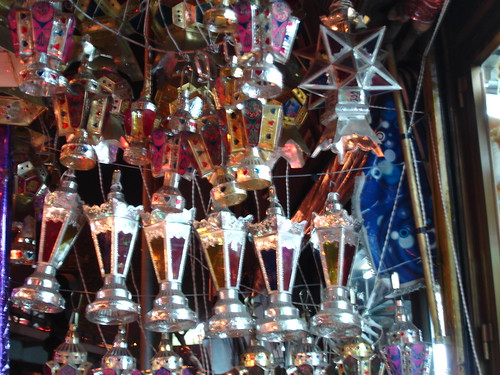
   Traditionally fawanees are made of tin and coloured glass (see pic above) by artisans all over the country, often using recycled scrap metal. Unfortunately recent years have seen an influx of cheap, mass-produced plastic lanterns from China. These often bear very little resemblance to the traditional fanoos, can play music (either traditional Egyptian Ramadan folk songs or the latest hits) and are completely lacking the soul and calender of the traditional models.

  The aforementioned Ramadan folk songs are another sign of the month, this first one is traditionally associated with the fanoos. Entitled "Wahawey ya Wahawey" it celebrates both Ramadan and the fanoos.


This second is a called "Ahlan Ramadan" or "Welcome Ramadan"


So, Ramadan Kareem to you all!!

All images on this page were found via Google Images. No copyright infringement intended. 

Saturday, June 26, 2010

Korba Festival!

   The first Korba Festival was held to celebrate the centenary of Heliopolis in 2005. Heliopolis was established in 1905 by Belgium Baron Empain, Ă‰douard Louis Joseph an amateur Egyptologist. When building on the new suburb began it was a stretch of desert 10 km away from the centre of Cairo (now known as Old Cairo or Masr El- Kadima), nowadays it is slap-bang in the centre of the city. 


  Since 2005 one street (Baghdad St.) in the Korba area of Heliopolis has been closed to traffic on a Friday to become a place where people can enjoy a stroll around through the street with shops and coffee shops spreading out onto the pavement to display their wares and entice you to spend. There's the chance to leave your mark by drawing on the roads and pavements in chalk and for several days afterwards it makes driving down that street a little bit more colourful. 


   This year the theme of the festival was Music the Language of Peace and featured various artists from around the world (don't ask who, I arrived late and missed the line-up!) the star attraction of the evening though was Egyptian jazz musician Yehia Khalil. The atmosphere was loud (this is Egypt after all) and electric with plenty to see and do and other music styles available further down the street if the music at the main street wasn't to your taste. 


  So if you're ever in Cairo and the Korba festival is on, I highly recommend you hop in a taxi and go have fun at the Heliopolis street party.


Myself.

Sunday, April 25, 2010

Egypt's Hidden Treasures.


The next time you come to Egypt, or even if it's your first time here, try and expand your horizons beyond the pyramids, the museum and temples. Yes I know the pyramids are awe-inspiring, the final resting places of kings who wished for immortality and have-in a way- achieved it should definitely be on your list. After all where else in the world can you see one of the original 7 wonders of the world? But this isn't all this country has to offer, there's so much more than just the Pharaohs and their treasures.

What you won't find advertised as much or on the zillions of cheap tourist tat available is the beauty of medieval Cairo. Known locally as Masr El-Kadima, or Old Cairo it contains Roman ruins and remains of the pre-Cairo capital of Egypt, El-Fustat. El-Fustat was built by the Arab Khalifa (literally; follower or he who comes after) Amr Ibn el Aas after the Arab conquest of Egypt in the 7th century. He built the first mosque in Africa in his new capital city. Cairo itself was not built till the 10th century during the Fatimid rule of Egypt and at that time it was a separate city to the north of El-Fustat. Eventually the cities merged as Cairo expanded and El-Fustat fell into disrepair.

The location of El-Fustat was near the Roman Babylon Fortress, which today is in the area known as Coptic Cairo. This area, as the name suggests, is home to some of the oldest churches in Cairo and is thought to have been where the Holy Family visited during their flight into Egypt. Most of the churches were not built until after the Arab/Islamic invasion of Egypt when Christians were tolerated unlike the persecution they faced under the Romans. The fortress itself has had churches built into or on its walls.

One of these churches is the Hanging Church of Babylon, so named because it was built on the gatehouse of the Roman Fortress, so its nave is suspended, or 'hanging' over a passageway. Due to the construction of the High Dam in Aswan, and the subsequent lack of floods has lead to the ground level rising and so the dramatic effect of the church has been somewhat lost. The church contains icons dating from the 8th century to the 18th and the alter is carved ebony and ivory decorated with coptic crucifixes.

In the Islamic area of Old Cairo has some of the most beautiful mosques in the city one of which is the Rifai Mosque ( el masged el Rifa'i) commissioned by the 19th century rulers of Egypt to complement the 11th century architecture of the Sultan Hassan Madrasah (madrasah literally means 'school' in Arabic but is most commonly associated with the learning of Quraan-Islam's holy book). The Mosque has a beautiful inner courtyard with a central water fountain area for wudu' (the ablutions performed before prayer) and this is surrounded by four areas for prayer. The mosque is the final resting place of, among others, King Farouk-the last King of Egypt.

For pictures of the places mentioned above please click here http://s2.photobucket.com/albums/y31/fruitcakegirl/Old%20Cairo/