Showing posts with label Patriotism. Show all posts

Sunday, August 18, 2013

Egypt; A brief history


To make it clear from the start, this piece will not cover the current events in any detail. I'm writing this in an attempt to help explain the history of the major players in the current situation in Egypt and why the situation is so polarized. I am neither a journalist nor a historian, so please forgive any errors (if you could point them out, politely, and explain where I went wrong please do so in the comments). I will try to be as impartial as possible.

The first thing to understand is that both the Armed Forces and the Muslim Brotherhood are deeply embedded in Egypt's modern history and social conscious.


The Muslim Brotherhood was formed in 1928 by school teacher Hasan Al Bana, with the aim of returning to a Caliphite stretching from Spain to Indonesia, taking the Quraan and Sunnah (sharia law) as the guide to politics and society. For most of its history the brotherhood has been officially banned from politics and outlawed as an organisation. The first time came after the assassination of the Egyptian Prime Minister and the second under President Nasser after an attempt on his life. Despite having supported the 1952 revolution that removed the monarchy from power, they disagreed with the secular goals of the new regime.

The organization has gained support manly through charitable work ( especially in the form of food and healthcare to the needy) and because they were the most prominent form of opposition. This may help explain the loyalty at a grass roots level that the Brotherhood has amongst people, especially the poor. Where state institutions failed them, especially on an economic level, they were there to help cover bills and provide help. And of course, there's no one so willing to join an organization in opposition than those already on the fringes of society where it provides a sense of belonging and importance.

At the beginning of the uprising in 2011, their leaders asked their members not to join any of the protests, however as the movement became more popular and it looked like the police might retreat they joined in. This was enough to give their candidate the edge in the elections; despite having said that they would not be putting forward a candidate.

People have always been incredibly distrustful of them, despite this enough people decided to give Morsi a chance over Ahmed Shafiq who had been PM under Mubarak, to give him a slim margin to win the elections despite an incredibly low voter turnout in the second round.

Then came all the broken promises: a Copt as Vice President, plenty of cabinet positions for women, cracking down on the interior ministry and police brutality, to name a few. Instead more members of the Brotherhood and islamist parties were placed in key ministerial positions.The Brotherhood's political wing The Freedom and Justice Party ( FJP) then flooded the ballots ( along with more extreme "Islamists"). All their campaigns around poorer neighbourhoods involved bags of basic food stuffs and they were everywhere.

Parliament was elected and promptly set to work, their primary concerns seemed to be lowering the legal marriage age (to 12!), overturning the ban on female gentile mutilation and not teaching foreign languages in schools as they are 'corrupt'. Nothing about increasing wages, manufacture or any plan for the economy apart from trying to secure an IMF loan.

Then came the constitutional declaration in November which gave the President sweeping powers and was full of enough holes that even someone,like me, who struggles with legal jargon could see problems down the road. That lead to protests and a sit in at the presidential Palace which was forcibly broken up and people died ( not by the security forces but by supporters of the President) to no official condemnation.

That's not counting the things that made daily life, if not unbearable for all, then certainly inconvenient, daily power cuts and water shortages, garbage in the streets.

The police weren't exactly helping during all this time, as a kind of unofficial protest to having some of their powers curtailed and their torture brought to a wider light, they stopped doing their jobs. Crime rates escalated.

So, when a group of people decided to start the 'Tamarod' or Rebel campaign to call for early elections they ended up gathering more signatures than Morsi had votes to win the election (the movement claims at least 20 million signatures). Security forces saw this as a chance to gain back their previous positions of power and get the all important public opinion on their side and they promised to do whatever the people wanted and that they would protect the anti-Morsi demonstrations on June 30.

Egyptians love their Armed Forces. This dates back to 1952 when the Free Officers Movement lead a coup to overthrow the king- unlike recent events the king willingly abdicated to prevent bloodshed. Because of the British occupation, it was also a liberation from foreign rule and lead to a surge of patriotism and nationalism. The two main leaders were Mohamed Naguib and Gammal Abd El Nasser and while the latter is the most famous, Naguib was actually Egypt's first president, who due to disagreements with Nasser has been relegated to the footnotes of Egyptian history (if included at all).
Nasser on the other hand, is not a figure history can ignore. Love him or hate him, he was a charismatic leader and a gifted orator whose humble backgrounds meant the majority of Egyptians found him relatable. With proclaimed socialist leanings he insured that 50% of parliament seats went to workers and farmers as well as distributing farm land to those who worked it. He nationalised the Suez Canal which lead to the retaliatory invasion of the Sinai peninsula by Britain, France and Israel. After stepping down following the Six Day Way in 1964, he was reinstated by popular demand.

After his death came Anwar El Sadat who opened up the economy through trade agreements and signed the Camp David agreement. It was during this time that mass migration of the rural poor to the cities began (devastating the agricultural sector) and immigration to Saudi Arabia and the Gulf states.

For centuries Egyptians of all religions had lived peacefully side by side with neighbours celebrating religious and secular holidays together. There was a thriving and vital Jewish community. There was vibrant art scene and nightlife and through it all, Egyptians held fast to their faiths. Many claim that this began to change once people who had been working in Saudi Arabia began to return to Egypt with money and spreading the more conservative and fundamental Whabi form of Islam practiced there. Starting with the assassination of President Sadat in 1981, there began a crackdown on various armed islamist groups (several of which were off shoots of the Muslim Brotherhood). The 90s in particular were a violent time in Egypt, with bombs on government facilities, civilians and tourists all common. The perpetrators were the Islamists who looked 'different' and who seemed to be speaking of a different Islam than that which the majority of Egyptians practiced. It sought to reshape the country and it's people. They threatened security and the economy and so people supported any steps taken against them.

This may go some way to explain Egyptians' love and loyalty to the Armed Forces. They see them as having restored national pride and dignity to the people after decades of foreign rule. The police state whose end was called for in 2011 grew out of people's readiness to put down the enemies of the military and those they see as threatening Egypt's national identity and security.

What you see happening now is an -almost inevitable- implosion of the supporters of these two decade old foes.

Many of those opposed to Morsi's rule and who are supporting the current crackdown feel let down by the West, especially the media. For years Muslims around the world have been screaming that not all Muslim are like Al Qaeda and are trying to bring down Western civilization. The way they see it, is that what the security forces are doing now is clamping down on an organization that has bred terrorists who have effected the lives of millions around the world. They resent being told by the Brotherhood supporters that they are not 'true Muslims' for not wanting to live under their rule as they have always practiced the Muslim faith diligently. They feel that they are responding to what we hear so many Western politicians say whenever a Muslim commits a crime in the name of Islam; standing up to the extremists.


I hope that this has in some way improved your understanding of the current situation and why each side is as passionate as they are. Please also remember that your own democracies have been around for much longer and have already gone through most of these teething problems.


Monday, November 28, 2011

Egyptian Elections 2011

     Today was the first day of voting for Egypt's Lower House of Parliament (Magles El Shaab مجلس الشعب) or The People's Assembly. As with almost everything political in Egypt this year, it was new and different. For a start, there were new names to vote for! Gone were the names of those who had dominated the parliament (and country) for decades and they were replaced by countless others. With all these new faces came new symbols (due to the low literacy rate in Egypt, each candidate and party is given a symbol so that illiterate voters know who to choose). I remember the only signs I would see around my neighbourhood were the camel and the crescent, both used by the National Democratic *snort* Party candidates. This time there was a veritable cornucopia of candidates to choose from (130 on my ballot paper) and their symbols ranged from the bizarre to the ridiculous (cookers, food mixer, tank, knife, shirt, carpet, chair, bouquet of flowers, gold ingot, water heater, bus, school bus, tram, train, basketball, basketball net and so on).
The main roundabout near my house becomes an election campaign hub

Some of the candidates' banners
There's a lovely fountain hidden behind all those banners
    Of course, this being Egypt, nothing is as simple as it first appears. Under former President Nasser an addition was made to the constitution stating that 50% of the Lower House should be composed of workers and farmers. A later amendment set the minimum % of women who must be MPs. This means that voting is not as straightforward as placing a check mark next to your preferred candidate's name. 
   
    Once in the polling station, you're given 2 papers; one to vote for the party and one for the individual candidates. Of the individual candidates you must choose 2, one of whom must be a worker. These individual candidates may be running as a member of a political party or as independents. Confused yet?

   My day began at 8:30 when I left home to head towards my polling station (polling stations were assigned according to your national ID number and so my parents and I were each at different stations despite sharing an address). I had no idea where the school serving as my polling station was, but I was lucky enough to meet up with 3 young ladies from my neighbourhood who were at the same one, and despite none of us knowing where we were going, we set off together. We found our school in a middle/working class area of Cairo called El-Zaitoun which is fairly conservative, it also has a large Coptic population which meant the queue was a mix of people voting for the Freedom and Justice Party (the political wing of the Muslim Brotherhood), a minority voting for the ultra-conservative Islamist El-Nour party and Christians who, like me, were voting for the more liberal or secular candidates.

   The queue was long, and seeing it was amazing as Egyptians are not famous for their patience or queue formation! It snaked around the block in a U shape and was twice as long when I left as it had been when I joined.
The queue in front of me. At this point we'd been in line for an hour and still had to turn the corner before we could even see the school gates.

Part of the queue (about halfway along) when I was leaving.
 We were all chatting, but none of us ever really discussed who we were voting for, we were just pleased that we were voting. There were a few people passing out flyers as we waited, despite this being against election rules which state that all campaigning had to have ceased 48 hours before the vote.  The actual voting only took a couple of minutes, as I knew exactly who I was voting for. So after a 3 hour wait, weeks of reading up on parties I made my 3 check marks, signed the register, dipped my thumb in the fluorescent ink and was done! I had voted for the first time!!


    Of course, none of this was imaginable a year ago and if people had not taken to the streets and squares in January, we would have "voted" for a new President next September only to have Gamal Mubarak win with 90% majority. There are  many who think this parliament will be a useless entity, there purely for show until the constitution has been reviewed and a President elected next year. They also say it may not even last beyond a couple of months. Whatever happens, for better or worse, Egyptians went to bed today feeling, for the first time, that they made a difference. So for that alone, I say, to everyone who protested, was injured and especially to those who gave their lives; "Thank You"


Wednesday, August 3, 2011

Mubarak in the Dock

    Today, August 3rd 2011 was the day deposed President Mohamed Hosni Mubarak finally had his day in court. After delays, and all the reports about the state of his health--"He's got terminal cancer." "No, he hasn't." "He's in a coma!", "No, he isn't."---Egyptians finally got what we wanted; Mubarak (and sons) in their white overalls in the accused's cage. And in an ironic twist of fate it was in the same hall (at the Police Academy) that Mubarak gave his last speech before the start of the January 25 protests which lead to his eventual downfall.

   Today was merely the opening session in the trial of Mubarak, his sons Alaa and (President in waiting) Gamal and former Minister of Interior Habib El-Adly (one of the slimiest human beings on the planet IMO). As such the lawyers of the defendants and the prosecution were presenting their arguments and demands for the trial. This was, unfortunately but not surprisingly, chaotic with only one microphone that had to be passed around amongst all the lawyers (there we several there representing the families of the martyrs in various areas of Egypt in civil suits against the deposed and the former MOI head.) which lead to the judge having to discipline the courtroom much as a teacher disciplines a classroom.

    Suzanne Mubarak was conspicuous by her absence today as were the wives of Alaa and Gamal. Suzanne is also facing charges relating to illegal profiteering during her husband's 30 year rule.

   It wasn't until after the first adjournment that the Mubarak and his sons were charged and called upon to state their pleas. Unsurprisingly all three pleaded 'not guilty.'. The charges against them included; ordering the shooting of protesters (could lead to the death penalty), selling Egypt's natural gas to Israel at greatly reduced prices (thus harming the economy). 


Highlights:
  • Seeing them in the cage! For non-Egyptian readers; this is normal procedure in Egyptian courts as it is in Russia I believe.
  • Mubarak picking his nose. 
  • Gamal and Alaa standing in front of Mubarak's stretcher in an attempt to hide him from the cameras. Didn't work.
  • The judge asking the lawyers if they had their demands written down or were going to waste time trying to remember them.
  • The public prosecutor listing the charges against Mubarak, Alaa and Gamal.
  • Hearing Mubarak say ' Ya Fandem' meaning 'yes sir.' to the judge to show he is present. He probably hasn't said that in 30 years!
  • The one conspiracy-theorist lawyer who demanded DNA tests on Mubarak to prove it's really him and that he didn't die in 2004.
  • THAT IT ACTUALLY HAPPENED!!! There's no denying that this is a historical day in Egyptian and Arab history. An Arab leader has never before been tried after being deposed by their own people. It was unthinkable a mere 7 months ago and right up until Mubarak was actually wheeled in, most people thought we would never seem him stand trial. 

      After a second adjournment the judge declared that Habib El-Adly would be tried separately for his role in the deaths of protesters and would resume tomorrow (it has already been postponed 3 times, although he has been found guilty of money laundering and profiteering). The Mubaraks' trial will be resumed on the 15th of August 2011 with Alaa and Gamal returning to Torah Prison where they have been held since February and Hosni Mubarak will be held in a military hospital on the Cairo-Ismaliia desert road. 

Friday, July 8, 2011

Revolution 2.0

     This Friday (July 8th) Egyptians around the country returned to major squares to reapply pressure on the Supreme Council of Armed Forces (SCAF) to ensure demands are met. These protests have been called for for a while but escalated following the release in Suez of 14 police officers accused of killing protesters during the 18 days of revolution in January and February. People in the city famous for the Canal have been protesting for most of last week after this court decision and this greatly helped raise the enthusiasm around the country to protest on Friday. 

     The atmosphere in Tahrir Sq. was great, a cross between a carnival, rock festival and in some parts a slightly more angry and grieving crowd. The demands were, as always, posted around the square on banners and placards carried by people.

   The demands vary according to political affiliations but there are those that are common across the board;

  • The swift and public prosecution of members of the former regime, most prominently former President Mubarak and former Interior Minister Habib El-Adly (the former's trial is -tentatively- set for August 3rd while the latter has had his trial into the deaths of protesters 3 times so far). 
  • Lifting of the emergency law. 
  • No military trials for civilians, and the immediate release of those already detained and convicted.
  • SCAF handing over power to a civilian panel to hold power till elections are held.
    The sit in is planned to continue until these demands are met. Hopefully it will continue peacefully and not be broken up by security forces in the middle of the night.

Friday, May 27, 2011

The Beauty of Egypt

   My friend Tarek created this absolutely stunning video that shows off the beauty in Egypt ( a couple of the shots are mine too!).

Have a  look and let it inspire you to visit, it's a brand new and ancient land all in one!


Thursday, April 28, 2011

Sharm El-Sheikh and Sham El Nessim

    Recently the Egyptian Red Sea resort of Sharm El-Sheikh has been in the news for all the wrong reasons. In 2010 there were a series of shark attacks that killed several people and since he was deposed in February 2011, former President Mubarak has taken up permanent residence in the city. Despite all this and the drop in visitor numbers since the Revolution, it is still a popular destination for tourists, especially those looking to combine sun, sea and sand and stunning natural beauty with an active nightlife. The waters of the Red Sea are ideal for snorkeling and scuba diving.

   Sham el-nessiem is an Egyptian national holiday and is a uniquely Egyptian way to welcome spring. It translates literally into "smelling the breeze"  and dates back to Pharaonic times. These days it falls on (Coptic) Easter Monday and is celebrated by all Egyptians irrespective of religion. It is celebrated, as most festivals in Egypt are, with food; in this case, coloured boiled eggs, green onions and salted fish (ringa and fessekh). These are usually eaten as part of a picnic as most families head off somewhere green. I remember when my cousins and I were young, we would all head off to the family orange grove and the smell of orange blossom still brings those memories back.

  This year a friend and I headed off to Sharm El-Sheikh for the long weekend and I have to say, it was one of the best ideas we'd had for a while! She was able to get us a good deal via her workplace so we were staying in a lovely 5 star resort at a fraction of the cost. The hotel was nice, the room large enough for the 2 of us not to constantly be in each other's hair and the view from the balcony was lovely
View from our room.
The other advantage this hotel had to the one I stayed at two years ago was that the beach was right within the resort. A three minute walk (through the pool area and garden) lead you to a walkway from which you had a glorious view of the red sea.
First view of the Red Sea

   While I would have been perfectly happy to spend all 4 days on the beach, snorkeling, reading and soaking up the sun, my friend had other ideas. She insisted that she wanted to climb Mount Sinai and visit St. Catherine's monastery. I was slightly less than enthusiastic as I had done this on my last visit and it was exhausting, freezing and took up a whole day. However, remembering just how tiring it was I felt I couldn't leave her to do it alone so we booked 2 places on a trip leaving the night we arrived. Unfortunately, the trip was poorly organized and our guide was rude, badly spoken and aggressive, but enough of that story now! On the bus journey to the mountain the air-con was on full blast and that was just enough to bring the cold I'd been keeping at bay all week to full strength. By the time we started the hike, my nose was completely stuffed and breathing and hiking at the same time was becoming problematic (I've discovered I like breathing...it helps keep me alive), so in the end I only made it as far as the first rest-stop on foot and then carried on on a camel!
Me on the camel watching the sunrise over Mount Sinai

    My camel pilot Saleh (a Bedouin native to Sinai) and I had a good chat as we made the trek up, he's been doing the job for about 3 years and that on a good day he can hire his camel about 4 times in either direction. The best tourists in his opinion are Indonesians as they nearly always opt for a camel ride up , while Russians are far less likely. I asked him how the revolution had affected business and he told me that they've definitely had fewer people this year but the numbers were starting to pick up again. 

  The view of the sunrise was as stunning as I remember and I'll let the pictures do the talking.


  In the end we weren't able to go around the monastery as the monks had decided to close to visitors in preparation for Easter services, but we did manage to use the facilities there and I snapped a picture of the door to the main church decked out for the occasion.


    Back at the hotel I took some paracetamol and slept for 12 hours straight! Luckily I got my wish and was able to spend the next 2 days on the beach.


Saturday, March 19, 2011

First Taste of Democracy!

   Today Egyptians took to the polls to vote in  the referendum on the proposed amendments to the constitution (for more details please see my post HERE).

   I'm 26 years old and I voted for the first time today. Even though I've been eligible to vote in Egypt since I was 18 there never seemed to be any point before, the results were a forgone conclusion; Mubarak's National 'Democratic' Party would win. In some cases even dead people would manage to vote!

  My brother and I were at our local polling station by 8:20 and there was already a queue winding its way from the office on the second floor to the street outside. By the time I left at 9, the queue had spread further down the street and I couldn't actually see the end of it when I came out, and that's just one of the polling stations in my area! Egyptians willingly and quietly lining up with no pushing or shoving is in itself is an amazing sight to behold!  

    The atmosphere was great, very positive and everyone was eager to ensure their voice will be heard, anyone who started to try and convince people to vote one way or another were told to keep their opinions to themselves and just vote when it was their turn. I had a woman behind me in the queue, whom I can only describe as a traditional Egyptian Mama, who was welcoming everyone who joined the line and told me she'd spent last night going around her neighbourhood reminding everyone that it was their right to vote and brought some of them with her today. She was talking about all the changes she's hoping to see in Egypt including an all-female police force to deal with sexual harassment. She got a big cheer for that one!

  In the end, I went into the polling room handed in my National I.D, took my ballot paper behind the screen, popped it in the box and dipped my finger in the fluorescent ink to prove I'd voted.

WHAT A FEELING!!

 To think that a mere 2 months ago, all this would have been impossible. In 3 months Egyptians have toppled a corrupt government and taken the first steps to re-build the country democratically. That's amazing.

  If you live in a democratic country, don't ever take your right to free and fair elections for granted. We had to fight and many died for us to get this far today. 
VOTE!

Wednesday, March 9, 2011

Tea and Politics.

   Well we didn't actually drink tea, but we most certainly spoke politics. A few nights ago my brother, a friend and I went to a friend's house to meet with a judge and former UN lawyer to talk politics and the discuss the future of Egypt.
 
   Conversation ranged from the structure of the country's justice system and the challenges facing those in it and the possible scenarios in Egypt's future. The major focus of the evening though, was the proposed amendments to the constitution. These amendments address several main areas:

  1. The President (who is eligible and time limits of office).
  2. Elections and voting.
  3. The appointment of a Vice-President.
  4. Emergency Law.
  5. Presidential use of military justice.
  6. Amending the constitution. 
For the full details of the amendments please click here Egypt's Constitutional Amendments

   Something that I hadn't realized before this meeting was that the old constitution is technically null and void since when Mubarak stepped down and handed control to the Supreme Council of the Armed Forces the constitution fell with him, because he left office due to a revolution. Legally our current constitution is what was issued by the SCAF in their communique which stated their intent to uphold the laws of the land and all international agreements and treaties ( a thinly veiled assurance to Israel regarding the Camp David peace agreement). This means that instead of simply amending the constitution, now is the best possible time to re-draft the entire document. The only possibility of this happening is if the proposed amendments are refused in the referendum to be held on March 19th.                                 

   One article that was not mentioned in the list of proposed amendments is the second article. This states that the official language of Egypt is Arabic, the official religion is Islam and that Islamic sharia is the only source of jurisprudence.  This is the section that a growing number of people have objections too. Egypt has approximately 10 million Coptic Christians and it is felt by them, and many Muslims, that this last section of the second article is unfair to this section of the population.

   What 'our' judge was able to tell us, is that in his professional experience this is only applied in family law and only to Muslims. Our host family was Coptic Christian and to hear the situation discussed rationally, calmly and intellectually from both points of view was refreshing, too often these conversations turn hostile. One of the points raised was that of religious education in school. One argued that from a very young age she felt "different" from her friends when the class was separated for religion classes. Her argument was that if this were removed from the curriculum (leaving religious education to the home and family) it may well go some way to removing the 'us and them' mentality which in cases may be subconscious.

   All in all it was one of the most interesting, stimulating and thought-provoking evenings I've had in a long time. I really hope we get a chance to repeat it.                                    

Saturday, February 12, 2011

The Day of Departure, Friday 11/02/2011


    Well. WE DID IT!!!!!!  Today President Hosni Mubarak stepped down as the head of state! Barely 24 hours after he had vowed to stay in office until presidential elections in September the Vice-President Omar Suliman announced that the President had 'in light of current circumstances' handed over the running of the country to the Supreme Council of the Armed Forces.

    The response was immediate and electrifying.

    Except maybe in my house. After hours spent watching Al-Jazeera Arabic my dad switched to the International channel then left the room. My brother got bored at the lack of developments and also walked away. So when history was made it was just my mum and I there. And we were only there because we were going to drink our tea!

   I admit, what Suliman said didn't register straight away. It took a couple of seconds for my brain to process what I had just heard. Mum and I were looking at each other making sure we'd each come to the same conclusion, then she leapt up to get my brother. By the time he'd come back out, my friend had rang and we'd agreed to go back down to Tahrir Square to celebrate.

   Like yesterday we took the Metro down to Tahrir. Oh but what a difference 24 hours can make! People were congratulating each other left, right and centre and everyone seemed to be smiling.

   It took us a lot longer to even get to the entry to Tahrir tonight because of the crowds. The sheer number of people in the streets and on the bridges shouting, cheering, waving flags and singing was amazing, and that was before we even reached the hub of the revolution.
Crowds on the bridge overlooking Ramses St.
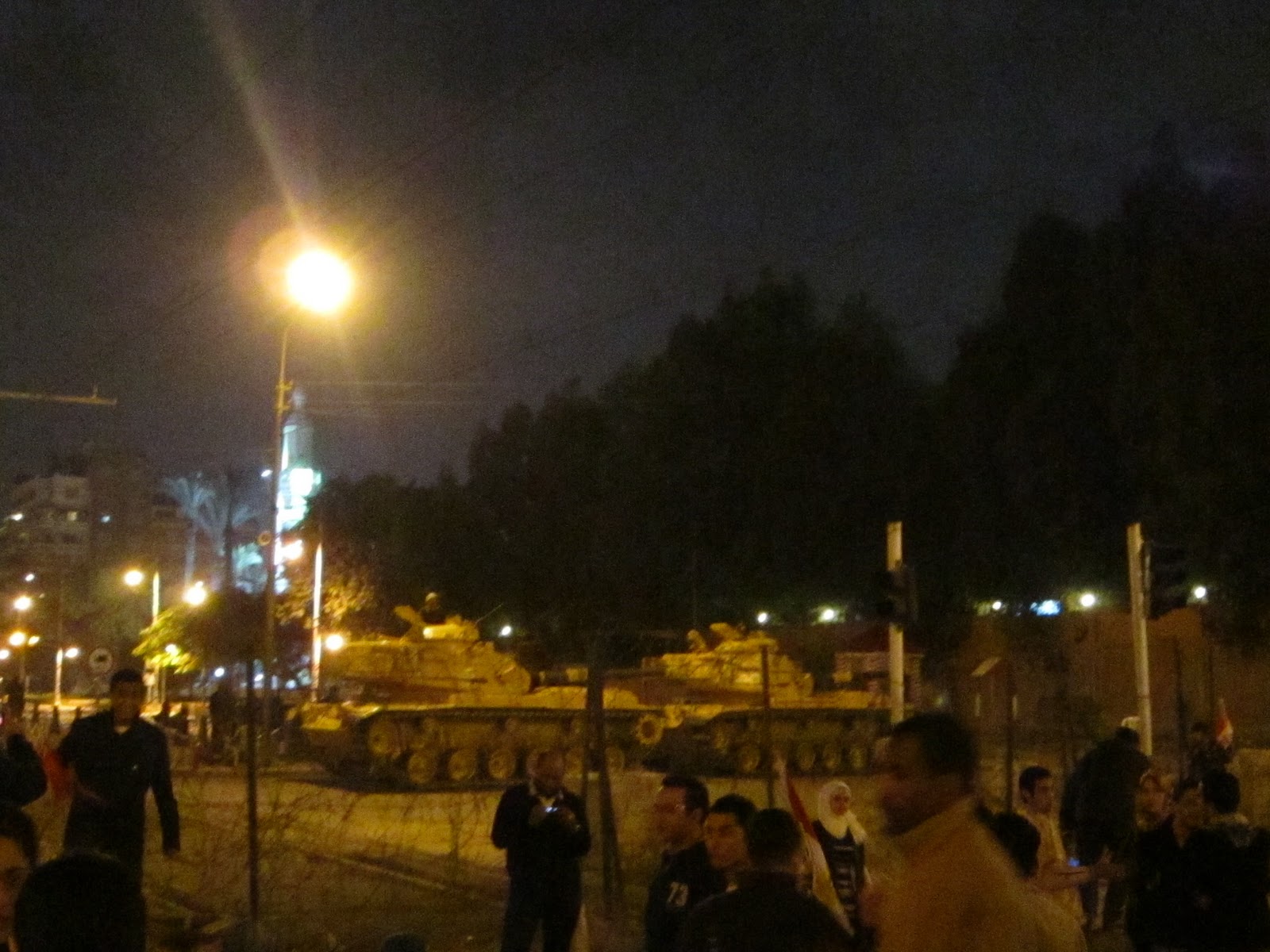
Tanks along Ramses St.
The Lawyers Syndicate
Crowds outside the Lawyers Syndicate

   Unlike yesterday we did not have to show our IDs or be searched before we passed the barricades told us 'there's too many people and we're free now!'. The sounds in Tahrir were incredible, it hit you the closer you got to the centre (unfortunately we weren't able to get right there tonight, too many people) and it didn't once let up.

   After Tahrir we headed back to the Metro to go to the Presidential Palace in Heliopolis. One of the Metro stations is called Mubarak Station (2 others are Sadat and Nasser) and last night people had crossed off his name and replace it with 'shuhad'aa' or Martyrs.
The newly renamed station.

More impromptu renaming 


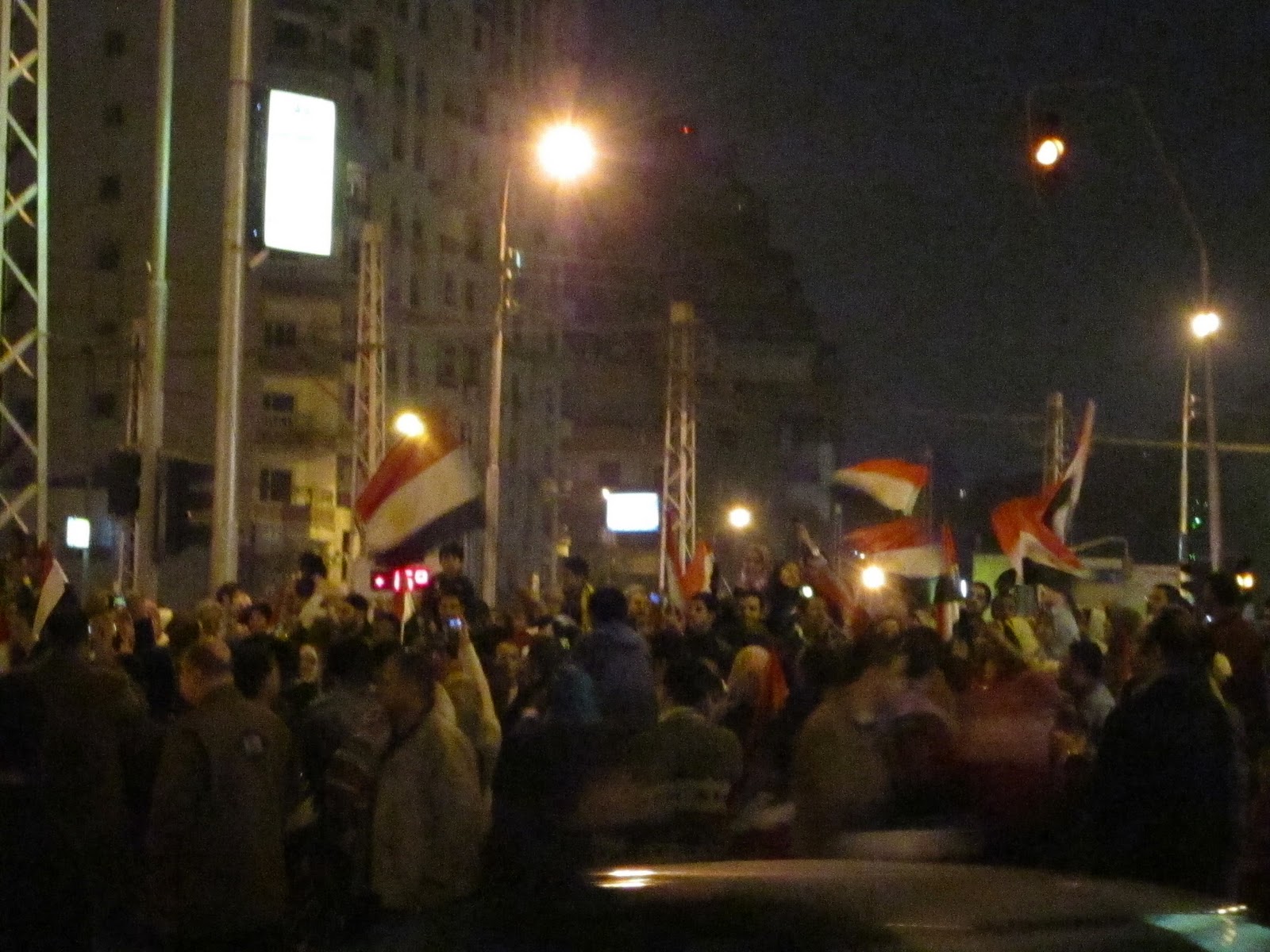
    The Presidential Palace is only 10 minutes away from my house and the surrounding neighbourhood is as familiar to me as the back of my hand. I've never seen it look like it did tonight and I doubt I ever will again.

  The noise, the sights and just the waves of sheer joy, relief and victory rolling off the people was indescribable. They say a picture speaks a thousand words, so instead of trying to describe it, here are some pictures of last night.


February 11th 2011 Egypt Reborn