Showing posts with label Traditions. Show all posts

Sunday, August 18, 2013

Egypt; A brief history


To make it clear from the start, this piece will not cover the current events in any detail. I'm writing this in an attempt to help explain the history of the major players in the current situation in Egypt and why the situation is so polarized. I am neither a journalist nor a historian, so please forgive any errors (if you could point them out, politely, and explain where I went wrong please do so in the comments). I will try to be as impartial as possible.

The first thing to understand is that both the Armed Forces and the Muslim Brotherhood are deeply embedded in Egypt's modern history and social conscious.


The Muslim Brotherhood was formed in 1928 by school teacher Hasan Al Bana, with the aim of returning to a Caliphite stretching from Spain to Indonesia, taking the Quraan and Sunnah (sharia law) as the guide to politics and society. For most of its history the brotherhood has been officially banned from politics and outlawed as an organisation. The first time came after the assassination of the Egyptian Prime Minister and the second under President Nasser after an attempt on his life. Despite having supported the 1952 revolution that removed the monarchy from power, they disagreed with the secular goals of the new regime.

The organization has gained support manly through charitable work ( especially in the form of food and healthcare to the needy) and because they were the most prominent form of opposition. This may help explain the loyalty at a grass roots level that the Brotherhood has amongst people, especially the poor. Where state institutions failed them, especially on an economic level, they were there to help cover bills and provide help. And of course, there's no one so willing to join an organization in opposition than those already on the fringes of society where it provides a sense of belonging and importance.

At the beginning of the uprising in 2011, their leaders asked their members not to join any of the protests, however as the movement became more popular and it looked like the police might retreat they joined in. This was enough to give their candidate the edge in the elections; despite having said that they would not be putting forward a candidate.

People have always been incredibly distrustful of them, despite this enough people decided to give Morsi a chance over Ahmed Shafiq who had been PM under Mubarak, to give him a slim margin to win the elections despite an incredibly low voter turnout in the second round.

Then came all the broken promises: a Copt as Vice President, plenty of cabinet positions for women, cracking down on the interior ministry and police brutality, to name a few. Instead more members of the Brotherhood and islamist parties were placed in key ministerial positions.The Brotherhood's political wing The Freedom and Justice Party ( FJP) then flooded the ballots ( along with more extreme "Islamists"). All their campaigns around poorer neighbourhoods involved bags of basic food stuffs and they were everywhere.

Parliament was elected and promptly set to work, their primary concerns seemed to be lowering the legal marriage age (to 12!), overturning the ban on female gentile mutilation and not teaching foreign languages in schools as they are 'corrupt'. Nothing about increasing wages, manufacture or any plan for the economy apart from trying to secure an IMF loan.

Then came the constitutional declaration in November which gave the President sweeping powers and was full of enough holes that even someone,like me, who struggles with legal jargon could see problems down the road. That lead to protests and a sit in at the presidential Palace which was forcibly broken up and people died ( not by the security forces but by supporters of the President) to no official condemnation.

That's not counting the things that made daily life, if not unbearable for all, then certainly inconvenient, daily power cuts and water shortages, garbage in the streets.

The police weren't exactly helping during all this time, as a kind of unofficial protest to having some of their powers curtailed and their torture brought to a wider light, they stopped doing their jobs. Crime rates escalated.

So, when a group of people decided to start the 'Tamarod' or Rebel campaign to call for early elections they ended up gathering more signatures than Morsi had votes to win the election (the movement claims at least 20 million signatures). Security forces saw this as a chance to gain back their previous positions of power and get the all important public opinion on their side and they promised to do whatever the people wanted and that they would protect the anti-Morsi demonstrations on June 30.

Egyptians love their Armed Forces. This dates back to 1952 when the Free Officers Movement lead a coup to overthrow the king- unlike recent events the king willingly abdicated to prevent bloodshed. Because of the British occupation, it was also a liberation from foreign rule and lead to a surge of patriotism and nationalism. The two main leaders were Mohamed Naguib and Gammal Abd El Nasser and while the latter is the most famous, Naguib was actually Egypt's first president, who due to disagreements with Nasser has been relegated to the footnotes of Egyptian history (if included at all).
Nasser on the other hand, is not a figure history can ignore. Love him or hate him, he was a charismatic leader and a gifted orator whose humble backgrounds meant the majority of Egyptians found him relatable. With proclaimed socialist leanings he insured that 50% of parliament seats went to workers and farmers as well as distributing farm land to those who worked it. He nationalised the Suez Canal which lead to the retaliatory invasion of the Sinai peninsula by Britain, France and Israel. After stepping down following the Six Day Way in 1964, he was reinstated by popular demand.

After his death came Anwar El Sadat who opened up the economy through trade agreements and signed the Camp David agreement. It was during this time that mass migration of the rural poor to the cities began (devastating the agricultural sector) and immigration to Saudi Arabia and the Gulf states.

For centuries Egyptians of all religions had lived peacefully side by side with neighbours celebrating religious and secular holidays together. There was a thriving and vital Jewish community. There was vibrant art scene and nightlife and through it all, Egyptians held fast to their faiths. Many claim that this began to change once people who had been working in Saudi Arabia began to return to Egypt with money and spreading the more conservative and fundamental Whabi form of Islam practiced there. Starting with the assassination of President Sadat in 1981, there began a crackdown on various armed islamist groups (several of which were off shoots of the Muslim Brotherhood). The 90s in particular were a violent time in Egypt, with bombs on government facilities, civilians and tourists all common. The perpetrators were the Islamists who looked 'different' and who seemed to be speaking of a different Islam than that which the majority of Egyptians practiced. It sought to reshape the country and it's people. They threatened security and the economy and so people supported any steps taken against them.

This may go some way to explain Egyptians' love and loyalty to the Armed Forces. They see them as having restored national pride and dignity to the people after decades of foreign rule. The police state whose end was called for in 2011 grew out of people's readiness to put down the enemies of the military and those they see as threatening Egypt's national identity and security.

What you see happening now is an -almost inevitable- implosion of the supporters of these two decade old foes.

Many of those opposed to Morsi's rule and who are supporting the current crackdown feel let down by the West, especially the media. For years Muslims around the world have been screaming that not all Muslim are like Al Qaeda and are trying to bring down Western civilization. The way they see it, is that what the security forces are doing now is clamping down on an organization that has bred terrorists who have effected the lives of millions around the world. They resent being told by the Brotherhood supporters that they are not 'true Muslims' for not wanting to live under their rule as they have always practiced the Muslim faith diligently. They feel that they are responding to what we hear so many Western politicians say whenever a Muslim commits a crime in the name of Islam; standing up to the extremists.


I hope that this has in some way improved your understanding of the current situation and why each side is as passionate as they are. Please also remember that your own democracies have been around for much longer and have already gone through most of these teething problems.


Monday, August 29, 2011

Here (Doesn't) Come The Bride

    *steps onto soapbox and clears throat*
   
     The other week I took my father to the hospital for his check-up. While there, we met my uncle who has a clinic in the same hospital. After the usual greetings and niceties, my uncle asked me what my brother was up to now and I proudly told him that he was off to London to do his Msc.at The London School of Economics in Human Rights. The next thing my uncle asks is whether or not I have any marriage plans in the near future "mafeesh 3rees wala eh?"

     Now I am well aware of how things are in Egypt, I grew up here after all. I know damn well that as soon as a girl hits puberty she is called '3roosa' or bride-this does NOT mean that Egyptians or Arabs in general condone child marriages, just that it is the beginning of what I see as brainwashing of young girls that they will grow up to be wives no matter what. 90% of the time this will come from a female relative and is always meant as a compliment. When I started university I remember an aunt telling me to make sure I didn't graduate without having "caught someone.". Well, I did catch someone, the wrong one as it turned out; but that's OK as far as I'm concerned because we didn't get married, there was no ugly divorce and no one got hurt but us.

    I don't feel I need to be married or in a relationship right now to feel 'successful' or 'complete', I wasn't raised that way. My parents' focus was always education, education, education not matrimony. So while there is a Tiffany&Co. ring that I think is gorgeous, I'm not bothered that I don't have one (and having seen the price tag, I'll probably never have one!). My point is this, I am more than just someone's future wife, I have a brain and I use it. I have opinions and I say them and I will argue to defend them. I don't want a 'protector and provider' I want a partner.

   I am not against marriage but it is not my sole goal in life I have other ambitions and I have no problems waiting for love, marriage and the baby carriage. I'm not rushing to meet men and when I do, I don't judge against a romantic ideal or a check-list (I tried writing one of those once, I struggled to get past 10 items).

   If I met the right man tomorrow and fell head over heels in love, then yes, I would want to marry him; not to feel like I've succeeded in some great game but because I would want to build a life with someone who will treat me as an equal.

*steps off soapbox*

Saturday, April 30, 2011

The Royal Wedding

   Yes it's a bandwagon and yes I'm jumping on it! I was really looking forward to watching the wedding with my best friend while we munched on sugary treats. As it turned out though, one of my teacher training courses was scheduled to start that day so I ended up watching parts of it via a live stream online while I sat in class.

   I thought the whole thing was beautiful, Westminster Abbey looked wonderful, the greenery and plants inside and the way the red carpet accentuated the memorial to the unknown soldier, apt considering William's military career.

   Catherine (Kate) looked absolutely stunning, very elegant and regal. I noticed that while William looked quite nervous when he first arrived at the Abbey, once the service began he was calm.

   They looked  very happy together and in love and I wish them all the best of luck. 

Thursday, April 28, 2011

Sharm El-Sheikh and Sham El Nessim

    Recently the Egyptian Red Sea resort of Sharm El-Sheikh has been in the news for all the wrong reasons. In 2010 there were a series of shark attacks that killed several people and since he was deposed in February 2011, former President Mubarak has taken up permanent residence in the city. Despite all this and the drop in visitor numbers since the Revolution, it is still a popular destination for tourists, especially those looking to combine sun, sea and sand and stunning natural beauty with an active nightlife. The waters of the Red Sea are ideal for snorkeling and scuba diving.

   Sham el-nessiem is an Egyptian national holiday and is a uniquely Egyptian way to welcome spring. It translates literally into "smelling the breeze"  and dates back to Pharaonic times. These days it falls on (Coptic) Easter Monday and is celebrated by all Egyptians irrespective of religion. It is celebrated, as most festivals in Egypt are, with food; in this case, coloured boiled eggs, green onions and salted fish (ringa and fessekh). These are usually eaten as part of a picnic as most families head off somewhere green. I remember when my cousins and I were young, we would all head off to the family orange grove and the smell of orange blossom still brings those memories back.

  This year a friend and I headed off to Sharm El-Sheikh for the long weekend and I have to say, it was one of the best ideas we'd had for a while! She was able to get us a good deal via her workplace so we were staying in a lovely 5 star resort at a fraction of the cost. The hotel was nice, the room large enough for the 2 of us not to constantly be in each other's hair and the view from the balcony was lovely
View from our room.
The other advantage this hotel had to the one I stayed at two years ago was that the beach was right within the resort. A three minute walk (through the pool area and garden) lead you to a walkway from which you had a glorious view of the red sea.
First view of the Red Sea

   While I would have been perfectly happy to spend all 4 days on the beach, snorkeling, reading and soaking up the sun, my friend had other ideas. She insisted that she wanted to climb Mount Sinai and visit St. Catherine's monastery. I was slightly less than enthusiastic as I had done this on my last visit and it was exhausting, freezing and took up a whole day. However, remembering just how tiring it was I felt I couldn't leave her to do it alone so we booked 2 places on a trip leaving the night we arrived. Unfortunately, the trip was poorly organized and our guide was rude, badly spoken and aggressive, but enough of that story now! On the bus journey to the mountain the air-con was on full blast and that was just enough to bring the cold I'd been keeping at bay all week to full strength. By the time we started the hike, my nose was completely stuffed and breathing and hiking at the same time was becoming problematic (I've discovered I like breathing...it helps keep me alive), so in the end I only made it as far as the first rest-stop on foot and then carried on on a camel!
Me on the camel watching the sunrise over Mount Sinai

    My camel pilot Saleh (a Bedouin native to Sinai) and I had a good chat as we made the trek up, he's been doing the job for about 3 years and that on a good day he can hire his camel about 4 times in either direction. The best tourists in his opinion are Indonesians as they nearly always opt for a camel ride up , while Russians are far less likely. I asked him how the revolution had affected business and he told me that they've definitely had fewer people this year but the numbers were starting to pick up again. 

  The view of the sunrise was as stunning as I remember and I'll let the pictures do the talking.


  In the end we weren't able to go around the monastery as the monks had decided to close to visitors in preparation for Easter services, but we did manage to use the facilities there and I snapped a picture of the door to the main church decked out for the occasion.


    Back at the hotel I took some paracetamol and slept for 12 hours straight! Luckily I got my wish and was able to spend the next 2 days on the beach.


Sunday, January 2, 2011

Happy New Year!

Yes, yes I know, I'm a day late. Better late than never though!  I wish you all a happy 2011 filled with love happiness, job satisfaction, unicorns and rainbows.

I will make a request of you though reader. Please pray, or wish upon a star or whatever you feel most comfortable with, that this year doesn't continue as it began with regards to the violence that has marred these first few days of the year.

Thank you xx

Monday, October 11, 2010

Egyptian Weddings

    The first thing you should know about Egyptian weddings is that they are loud. LOUD! The loudest part is the 'zaffa', this is the procession the bride and groom take-usually into the hall where the wedding is taking place. They are preceded by a band of traditional musicians with 'tablas' , the traditional Arab drum, trumpets and occasionally dancers with candelabras on their heads. There are traditional wedding songs, usually singing the praises of the bride and the joys of marriage. The zaffa can be as long or as short as the couple want but I've never attended a wedding where the zaffa has been shorter than 10 minutes. Sometimes the couple spend some of this time dancing with each other and friends and family, other times they simply watch on as others dance, it just depends on the couple's preference. As with anything else, the quality of the zaffa, in terms of musicians depends on the amount of money spent on the band, the songs are the same across the board but the difference is seen in the costumes worn by the band members.

    Once the happy couple reach the doors of the hall they do not simply walk through. Oh no. As if the last 10-20 minutes hasn't been enough of a hint that they're ready to party, they are whisked away into a ante-chamber before a big announcement to mark their entrance. Once in the hall, they usually head to the 'kosha' a seating area reserved for the couple, usually on a slight stage. Depending on the couple they may either spend most of the wedding there, talking to guests and having pictures taken or they barely sit down, spending the whole time dancing. Different strokes, different strokes.

     Some weddings will include the 'katb ketab' the actual marriage vows part, if they don't then the couple have already tied the knot officially and have decided to split the celebrations.

    As usual the highlight of any wedding is the buffet. Don't expect a piece of wedding cake, as my friend colleague and fellow blogger IrishAlexandrain recently discovered, there's a high probability that the cake is actually a foam model and the bride and groom cut a piece of cake hidden to one side.

    The most important thing to remember about Egyptian weddings is that they never start on time. If your invitation says 8:30, don't go before 9:30 and don't expect anything to happen till 10 at the earliest. Most are held in hotels at night although it's starting to become popular to have alternate venues. Some people rent villas out for the occasion, allowing for an outdoor party.

Thursday, September 9, 2010

Eid time!!

   Well folks, it's that time again. After a month of fasting from dawn till sunset Muslims around the world will tomorrow (10/9/2010) celebrate Eid El-Fitr-a three day celebration of the end of Ramadan which literally translates into the feast of breaking the fast.
   The streets will be filled with the sounds of celebration and children's play (in fact I can already hear the fire-crackers going off in my street). One of the traditions of Eid is to buy a new outfit for at least the first day of festivities so the shops have extended their sales in the weeks leading up to Eid to entice people to spend. For those less fortunate, donations of second-hand clothes will be distributed so that underprivileged children will get to experience a sense of joy at this time of the year. Families will meet up, either at the grandparents or go away together for the break to the beach or maybe the family farm.
     Once again people will be able to turn to Caffeine first thing in the morning to help get them through the rest of the day. Snacking can once again begin in earnest despite the plans of many to stop this year so as not to regain any weight lost over the holy month. But few will be able to resist traditional Eid cookies or Kahk, a buttery biscuit sometimes filled with dates and sprinkled with icing sugar. A delightful sugar rush after a month of daytime lethargy.

Eid Saeed everyone!
 PS: When the internet begins cooperating again, I'll upload a link to an Eid song!

Saturday, August 21, 2010

Ramadan and Food!

   A nice juicy steak with all the trimmings. A big bowl/plate of pasta. A pizza with your favourite topping. Roast potatoes. Molokhya*. Fatta*.  Whatever food you like, and sometimes even ones you don't like much, at some point during the  day in Ramadan you will be thinking about food. If you're not thinking about it, you're talking about it. Or watching a cooking programme. Or reading recipes. Or shopping for/preparing food for Iftar-literally breakfast-the main meal of the day. 

  It may be breakfast Jim, but it's not as we know it! Forget cereal, toast and pancakes. This is a breakfast of soup and dates rice or potatoes of vegetables and meat, especially  in Egypt, meat reigns supreme. No gathering of friends or family would be complete without copious amounts of meat. Red meat cooked in various ways, chicken, turkey, you name it, chances are it'll be on the table!
  
A traditional liquorice juice seller.
  The juices are equally varied but usually include Ammr elDin which is an apricot drink, made from sheets of dried apricots dissolved in hot water (much like sheets of gelatin). Karkadeh is a tea made from the hibiscus flower and can be served hot or cold. Kharoub  is another favourite in my house as is liquorice. All these drinks have medicinal benefits,  some can help regulate blood pressure (Karakadeh lowers while liquorice increases), cholesterol and blood sugar levels-essential when a person has been fasting.  


  And now, dessert! Although the sweets eaten in Ramadan are available all year round, they have a special place in any Ramadan meal. In Egypt most people stick to Oriental sweets at this time of the year, the most popular being konafa a dish made with shredded fillo pastry, drenched in syrup and stuffed with nuts or cream or raisins. Basbousa is a semolina dessert again cooked with syrup. Baklava, golash (pastry not meat) and various other sweet things also make an appearance. 


  Sohoor  is the meal eaten about an hour before dawn as a chance to fill up the tank before another day of fasting (all that food from earlier doesn't count!). This is a much lighter meal usually of eggs, fool( broad beans) and cheese. 


  It should be noted at the end of this piece that although food plays a major part of this holy month, it is about much much more. This is the first time I've experienced Ramadan in the heat of summer (Ramadan gets earlier by about 11 days each year, following the lunar cycle) and never in my life have I been more grateful for a glass of cold water and count my blessings that I have access to clean, safe drinking water. And that is the main reason behind this month, to remind us of how lucky we are to be able to eat and drink and to give a taste (if you'll excuse the pun) of how people with little or no food and water feel everyday and to remind us to help as many of those people as we can. A common sight in streets during this month is Moa'ed Rahman  or Mercy Tables where people pay or provide food to feed the needy, these are open to anyone all throughout the month.


All images were found using Google Images. No copyright infringement intended. 

Wednesday, August 11, 2010

Ramadan Lanterns


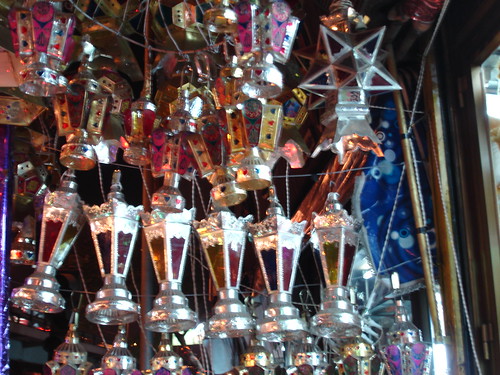
   Well it's that time of the year again; Ramadan! The ninth month of the Islamic Hijri calender. (The word Hijri comes from the Arabic word Hijra or migration, as the Islamic calender counts years from the Hijra-when the Prophet Mohamed left persecution in Mecca for Medina.) In Egypt one of the most obvious signs that the Holy month of fasting and piety is about to begin, apart from worse-than-normal traffic, is the appearance of the 'fanoos' or the Ramadan lantern.

    The origins of the fanoos isn't exactly clear some think it is an evolution of the use of candles in certain Ancient Egyptian religious ceremonies which was adopted by Coptic Christians and then by Muslims. The story I've heard most often is that the use of the fanoos during Ramadan was popularized during the Fatamid period when the Chaliphe ordered the streets of Cairo be lit at night by lanterns.


   Traditionally fawanees are made of tin and coloured glass (see pic above) by artisans all over the country, often using recycled scrap metal. Unfortunately recent years have seen an influx of cheap, mass-produced plastic lanterns from China. These often bear very little resemblance to the traditional fanoos, can play music (either traditional Egyptian Ramadan folk songs or the latest hits) and are completely lacking the soul and calender of the traditional models.

  The aforementioned Ramadan folk songs are another sign of the month, this first one is traditionally associated with the fanoos. Entitled "Wahawey ya Wahawey" it celebrates both Ramadan and the fanoos.


This second is a called "Ahlan Ramadan" or "Welcome Ramadan"


So, Ramadan Kareem to you all!!

All images on this page were found via Google Images. No copyright infringement intended.